Global data forecast for 2025. The volume we have to keep keeps compounding.
IDC, Data Age 2025 (2018)DNA data storage · software platform
Data that
outlives us.
DNARISE is building the software layer for DNA data storage. It turns any file into DNA, predicts how long that DNA survives, and proves every byte comes back. Our research-calibrated simulator is live today.
01 — The problem
We're writing the world's memory on media that forget.
not centuries
Disks and tapes wear out and formats go obsolete. Archives have to be copied onto new media again and again.
on
Keeping "cold" data alive still costs power, cooling, floor space and migrations, every year, forever.
02 — Why DNA
Nature's storage medium, refined over billions of years.
Information density reported for the DNA Fountain encoding. A single gram of DNA could hold a data centre's worth of archives.
Erlich & Zielinski, Science (2017)That is what one week at 70 °C stands in for. In accelerated ageing, silica-encapsulated DNA kept its data through it, the equivalent of about 2,000 years in a cool climate.
Grass et al., Angewandte Chemie (2015)obsolete
DNA is the code of life. As long as biology and medicine read it, our archives stay readable, and reading keeps getting cheaper.
03 — How DNARISE works
Follow one file through a thousand years.
-
01
Encode. Cut, address, protect.
Your file is split into 126-letter DNA strands. Each strand carries an address and a repair code, and spare strands are computed from the data so that lost pieces can be rebuilt. Every strand follows the rules DNA synthesis needs.
- One bar = one DNA strand, coloured by its A·C·G·T letters
- Spare strand
- Reed–Solomon inner + outer code
- GC 45–55 %
- No runs over 3 letters
-
02
Preserve. Age it before you make it.
We simulate decades to millennia of storage, covering the protection format, temperature and seasonal swings. The decay rates come from published accelerated-ageing studies.
Simulated storage0years- Protective silica shell
- Strand broken by time
- Arrhenius kinetics
- Silica & sealed-capsule models
- Uncertainty bands
-
03
Read. Thousands of noisy copies, voted into one.
Synthesis, PCR and sequencing errors are modelled on 40 published sequencing experiments. Reads are aligned and voted on, repair codes fix what is left, and spare strands stand in for any that broke.
- Reads streaming off the sequencer
- Damaged
- Repaired
- Trace reconstruction
- Errors-and-erasures decoding
- Gimpel et al. 2023 error model
-
04
Verify. Exact — or it doesn't count.
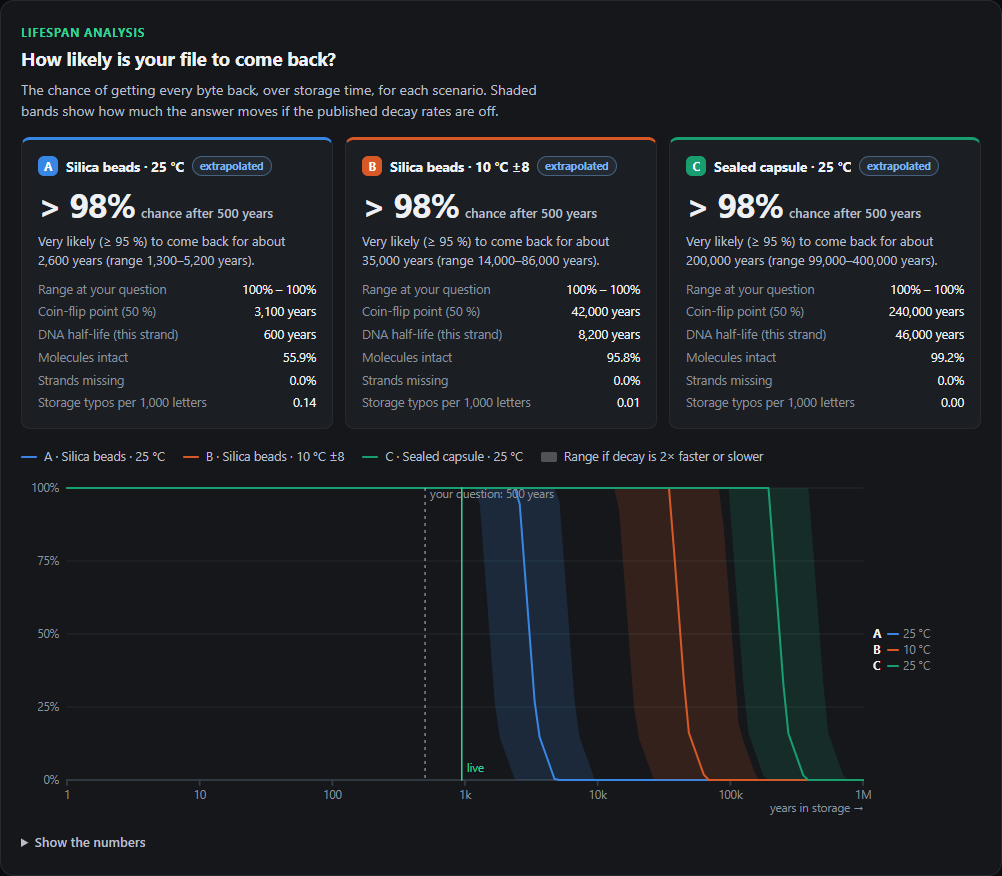
A SHA-256 fingerprint checks every byte. Thousands of simulated runs turn that check into a probability of exact recovery over time, with uncertainty and a source for every parameter.
- Every strand back in place: the file is rebuilt
- SHA-256
- Monte Carlo
- Provenance-tagged parameters
04 — See it in action
A letter, a lab, and a thousand years.
A three-minute walkthrough: why we need a new kind of archive, how DNA storage works, and the DNA Archive Lab simulating a real file, step by step.
05 — Live today
DNA Archive Lab
A research-calibrated simulator that runs entirely in the browser. Drop in a file, watch it age strand by strand, and get the probability it comes back, with a source for every number.
Open the lab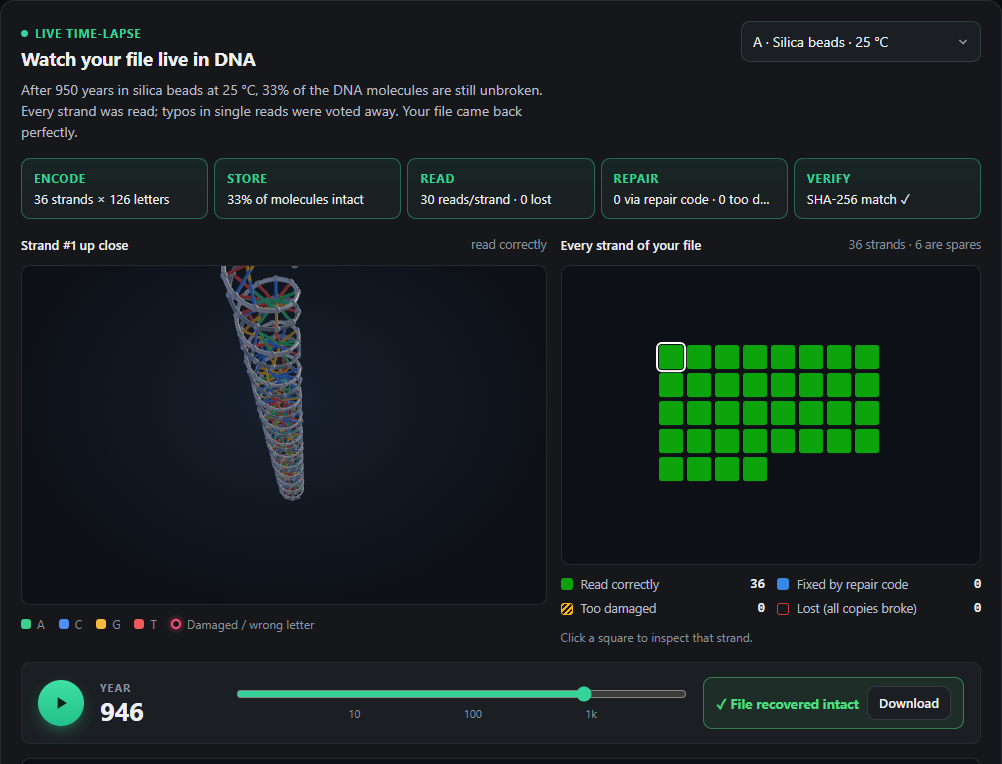
- Live time-lapseWatch every strand break, get voted and get repaired as the years pass.
- Lifespan analysisRecovery probability over time for up to three storage scenarios side by side.
- Provenance built inEvery parameter is tagged as measured, derived or assumed, with its source.
- Real error correctionInner and outer Reed–Solomon codes, trace reconstruction, SHA-256.
- Private by designFiles never leave the device. All computation runs locally.
- ReproducibleSeeded runs and exportable reports, ready to re-check.
06 — Evidence
Built on published science, not hand-waving.
Nature Communications · 2023
A digital twin for DNA data storage
Synthesis, PCR, sequencing and ageing error rates from 40 sequencing experiments.
Gimpel et al.
Angewandte Chemie · 2015
DNA in silica with error-correcting codes
Silica encapsulation and decay kinetics, plus the Reed–Solomon architecture our codec follows.
Grass et al.
PLOS ONE · 2021
Long-term conservation of DNA at ambient temperature
Breakage rate and activation energy for sealed anhydrous capsules.
Coudy et al.
Communications Biology · 2022
Information decay and enzymatic recovery
Strand breaks as the dominant information loss; silica half-life anchor.
Meiser et al.
Science · 2017
DNA Fountain
Sequence constraints (GC balance, homopolymers) and record information density.
Erlich & Zielinski
BMC Bioinformatics · 2025
DNA-Storalator
End-to-end simulation pipeline and the trace-reconstruction family we use.
Technion DNA Storage group
07 — Roadmap
From validated simulation to the first physical archive.
- Now · live Simulation platform Lab-aware codec, research-calibrated write/store/read channel, lifespan Monte Carlo, provenance.
- Next Lab-ready design Primers and adapters, benchmarks against published codecs, similarity clustering, validation on public datasets.
- Then First physical archive With synthesis and sequencing partners: one real write → preserve → read → hash-verify.
- Later Archive service Approval-gated ordering, sample custody tracking, verified recovery reports.
Help us build the archive that outlives us.
We're talking to investors and lab partners about the next phase: taking DNARISE from validated simulation to the first physical DNA archive.